
Call to Worship:
(Psalm 23, 1 John 3:16-24)
Day by day, God leads us:
to the deep, deep pools of peace,
to the green, lush lawns of grace.
Day by day, Jesus calls us:
to pour out ourselves in service,
to anoint the stranger with hope.
Day by day, the Holy Spirit shows us:
the community we could be,
the family we are called to become.
written by Thom Shuman on Lectionary Liturgies.
https://re-worship.blogspot.com/2012/04/contemporary-call-to-worship-easter-4.html
STF 18 Be still and know that I am God
Be still and know that I am God.
Be still and know that I am God.
Be still and know that I am God.
I am the Lord who saves and heals.
I am the Lord who saves and heals.
I am the Lord who saves and heals.
In you, Lord God, I put my trust.
In you, Lord God, I put my trust.
In you, Lord God, I put my trust.
Anonymous. Based on Psalm 46 , a division of David C Cook tym@kingsway.co.uk> Used by permission.CCL:I Song Number: 4662491
Bible Reading
Matthew 21: 33-46
The Parable of the Wicked Tenants
‘Listen to another parable. There was a landowner who planted a vineyard, put a fence around it, dug a wine press in it, and built a watch-tower. Then he leased it to tenants and went to another country. When the harvest time had come, he sent his slaves to the tenants to collect his produce. But the tenants seized his slaves and beat one, killed another, and stoned another. Again he sent other slaves, more than the first; and they treated them in the same way. Finally he sent his son to them, saying, “They will respect my son.” But when the tenants saw the son, they said to themselves, “This is the heir; come, let us kill him and get his inheritance.” So they seized him, threw him out of the vineyard, and killed him. Now when the owner of the vineyard comes, what will he do to those tenants?’ They said to him, ‘He will put those wretches to a miserable death, and lease the vineyard to other tenants who will give him the produce at the harvest time.’
Jesus said to them, ‘Have you never read in the scriptures:
“The stone that the builders rejected
has become the cornerstone;
this was the Lord’s doing,
and it is amazing in our eyes”?
Therefore I tell you, the kingdom of God will be taken away from you and given to a people that produces the fruits of the kingdom. The one who falls on this stone will be broken to pieces; and it will crush anyone on whom it falls.’
When the chief priests and the Pharisees heard his parables, they realized that he was speaking about them. They wanted to arrest him, but they feared the crowds, because they regarded him as a prophet.
Time to reflect:
Living as Tenants in God’s Vineyard
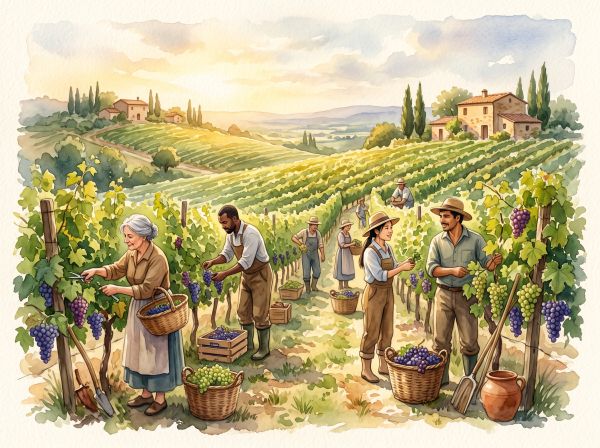
When we first hear the parable of the wicked tenants, it can appear quite clear-cut. A landowner plants a vineyard, cares for it, protects it, and then entrusts it to tenants. But when the time comes for the harvest, those tenants refuse to give the owner what belongs to him. They mistreat his servants, and eventually, when the owner sends his son, they kill him too.
It can be tempting to paint this parable with one brush and one colour, deciding immediately who the good people are and who the bad people are.
Traditionally, it has sometimes been interpreted as a condemnation of the Jewish people for rejecting Jesus. But we need to be careful with that interpretation. Matthew was writing after the death and resurrection of Jesus, within a community wrestling with its identity, faith and relationship with fellow Jews. The Gospel emerged from a particular time, culture and context.
So rather than using this parable to point a finger at somebody else, perhaps we might allow it to hold up a mirror to ourselves. Jesus’ parables often do that. They challenge us and invite us to look again. At the centre of this parable stands Jesus, the cornerstone. The stone that was rejected becomes the stone upon which something new can be built.
Perhaps, then, the question is not simply, “Who were the wicked tenants?” Perhaps the more important question for us is, “What kind of tenants are we?”
Imagine ourselves inside the parable, standing in the vineyard. God has entrusted something precious to us: creation, our communities, our churches, our relationships, our gifts, our resources, and even the days of our lives. We are tenants of God’s vineyard.
A tenant is someone who lives within and cares for something which ultimately belongs to another. A good tenant recognises that what has been entrusted to them should be treated with care, honour and respect. If we see ourselves in that way, perhaps it changes how we understand our place in the world.
Creation is not simply ours to consume. Other people are not here merely to serve our interests. The church does not belong to us. Our possessions are not simply for ourselves. Everything we have is, in some way, a gift. Therefore, discipleship asks us to live in God’s vineyard in such a way that all creation can flourish.
That means loving our neighbour, caring for the earth beneath our feet, noticing those who are overlooked, welcoming those who are excluded, and standing alongside those whose voices struggle to be heard. It means refusing to create a vineyard where only we flourish.
Perhaps that is the danger revealed in the tenants. They began behaving as though the vineyard belonged entirely to them. They lost sight of the one who had entrusted it to their care. Maybe that temptation is more familiar than we would like to admit. We can become focused upon ourselves, our needs, our church and our community, and forget that the vineyard is much bigger than ourselves.
So how might we live differently? Jesus gives us our foundation: Christ the cornerstone. If Christ really is our cornerstone, then our lives are called to take their shape from his life: compassion rather than indifference, generosity rather than possession, welcome rather than exclusion, and service rather than self-interest.
John Wesley famously encouraged Christians towards a faith expressed in doing all the good that we can, wherever and whenever we have the opportunity. That is life in God’s vineyard. It might mean checking on a neighbour who is lonely. It might mean making choices that care more gently for creation. It might mean sharing what we have. It might mean welcoming someone who feels they do not belong, or simply taking time to listen.
And importantly, this is not about ignoring ourselves or believing that our own needs do not matter. Jesus calls us to love our neighbour as ourselves. We too are part of God’s beloved creation. The vision of God’s vineyard is not that some flourish while others are diminished. It is about seeking a world in which our neighbour flourishes, creation flourishes, and we flourish together. We therefore live within it not as owners, but as grateful tenants: loving generously, caring faithfully, sharing freely, and doing all the good we can with all that God has placed.
Perhaps this difficult parable leaves us with three simple questions to carry into the coming week: What has God entrusted to me? Am I caring for it in a way that enables others to flourish? And is Jesus truly the cornerstone upon which I am building my life? Amen
Prayers of intercession
You are invited to pray silently for:
The needs of the world…
The Church and its calling…
Loved ones going through difficult times…
For peace, justice, and reconciliation…
In Jesus name.
Amen.
The Lord's Prayer
Please use the version that you prefer
Our Father, who art in heaven,
hallowed be thy Name,
thy kingdom come,
thy will be done,
on earth as it is in heaven.
Give us this day our daily bread.
And forgive us our trespasses,
as we forgive those who trespass against us.
And lead us not into temptation,
but deliver us from evil.
For thine is the kingdom,
the power, and the glory,
for ever and ever.
Amen.
Our Father in heaven,
Hallowed be your name,
Your kingdom come,
Your will be done,
On earth as in heaven.
Give us today our daily bread.
Forgive us our sins
As we forgive those who sin against us.
Save us from the time of trial
And deliver us from evil.
For the kingdom, the power
and the glory are yours
Now and for ever.
Amen.
STF 563 O Jesus I have promised
O Jesus, I have promised to serve thee to the end; Lord, be for ever near me,
my Master and my Friend;
I shall not fear the battle if Thou art by my side, nor wander from the pathway
if Thou wilt be my Guide.
O let me feel Thee near me, the world is ever near; I see the sights that dazzle,
the tempting sounds I hear;
my foes are ever near me,
around me and within;
but, Jesus, draw Thou nearer,
and shield my soul from sin.
O let me hear Thee speaking in accents clear and still, above the storms of passion,
the murmurs of self-will;
O speak to reassure me,
to hasten or control!
O speak, and make me listen,
Thou Guardian of my soul!
O Jesus, Thou hast promised to all who follow Thee that where Thou art in glory
there shall Thy servant be;
and, Jesus, I have promised
to serve Thee to the end;
O give me grace to follow,
my Master and my Friend!
Jogn Ernest Bode (1816-1874)
Blessing
(from Psalm 91: 1,4)
As you go from here, remember this: Those who live in the shelter of the Most High will find rest in the shadow of the Almighty. He will shield you with his wings. He will shelter you with his feathers. His faithful promises are your armour and protections. So go out with peace and joy, to love and serve God.
Amen
https://re-worship.blogspot.com/2013/02/benediction-psalm-91_11.html