
Opening Prayer:
Living God, as we worship at home, we ask you to draw near and walk with us. We confess that our eyes are often closed to your presence by the worries and cares of this world. Forgive our unbelief and open the scriptures to us today. May we feel the warmth of your Holy Spirit and find comfort in the truth that your kingdom is not shaken and never fails. In the name of the risen Christ, we pray.
Amen.
StF 314 This joyful Eastertide
This joyful Eastertide,
what need is there for grieving?
Cast all your cares aside
and be not unbelieving:
Come, share our Easter joy
that death could not imprison,
nor any power destroy,
our Christ, who is arisen!
No work for him is vain,
no faith in him mistaken,
for Easter makes it plain
his kingdom is not shaken:
Then put your trust in Christ,
in waking and in sleeping.
His grace on earth sufficed;
he’ll never quit his keeping:
Fred Pratt Green (1903–2000)
Words: © 1969, Stainer & Bell Ltd, 23 Gruneisen Road, London N3 1DZ www.stainer.co.uk CCLI Song Number: 996388
Bible Reading
Luke 24: 13-35
The Walk to Emmaus
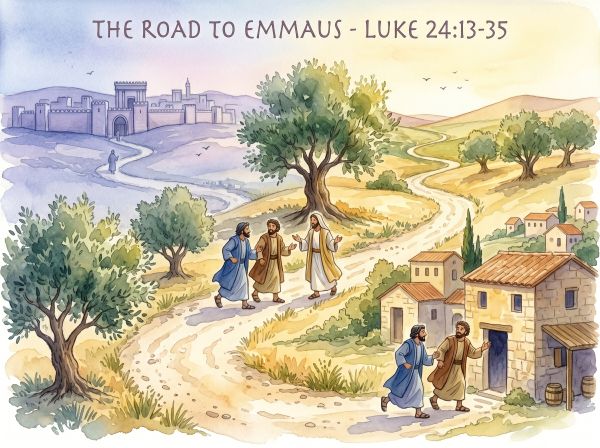
Now on that same day two of them were going to a village called Emmaus, about seven miles from Jerusalem, and talking with each other about all these things that had happened. While they were talking and discussing, Jesus himself came near and went with them, but their eyes were kept from recognizing him. And he said to them, ‘What are you discussing with each other while you walk along?’ They stood still, looking sad. Then one of them, whose name was Cleopas, answered him, ‘Are you the only stranger in Jerusalem who does not know the things that have taken place there in these days?’ He asked them, ‘What things?’ They replied, ‘The things about Jesus of Nazareth, who was a prophet mighty in deed and word before God and all the people, and how our chief priests and leaders handed him over to be condemned to death and crucified him. But we had hoped that he was the one to redeem Israel. Yes, and besides all this, it is now the third day since these things took place. Moreover, some women of our group astounded us. They were at the tomb early this morning, and when they did not find his body there, they came back and told us that they had indeed seen a vision of angels who said that he was alive. Some of those who were with us went to the tomb and found it just as the women had said; but they did not see him.’ Then he said to them, ‘Oh, how foolish you are, and how slow of heart to believe all that the prophets have declared! Was it not necessary that the Messiah should suffer these things and then enter into his glory?’ Then beginning with Moses and all the prophets, he interpreted to them the things about himself in all the scriptures.
As they came near the village to which they were going, he walked ahead as if he were going on. But they urged him strongly, saying, ‘Stay with us, because it is almost evening and the day is now nearly over.’ So he went in to stay with them. When he was at the table with them, he took bread, blessed and broke it, and gave it to them. Then their eyes were opened, and they recognized him; and he vanished from their sight. They said to each other, ‘Were not our hearts burning within us while he was talking to us on the road, while he was opening the scriptures to us?’ That same hour they got up and returned to Jerusalem; and they found the eleven and their companions gathered together. They were saying, ‘The Lord has risen indeed, and he has appeared to Simon!’ Then they told what had happened on the road, and how he had been made known to them in the breaking of the bread.
Time to reflect:
On the road to Emmaus two disciples walk and talk together, weighed down by disappointment and confusion. Yet it is into that confusion and uncertainty that Jesus comes alongside as a companion on the road.
Jesus does not arrive with a grand announcement.
Instead, quietly and almost unnoticed Jesus himself came near and went with the disciples. Yet, they were kept from recognising him. There is something both comforting and challenging in this detail. It is comforting because it reminds us that Christ is present even when we are unaware of him being with us, walking with us in our confusion, our grief, and our questioning. However, it is challenging because it suggests that we may often be unable to recognise his presence, even when he is close at hand.
Why are the disciples kept from recognising Jesus? Perhaps it is because they had been previously looking for a triumphant figure who would redeem Israel in obvious, unmistakable, and expected ways. Perhaps the disciples had carried the same expectations that the crowds had carried when Jesus triumphantly entered Jerusalem: To overthrow the Roman oppressors and make Israel great again? A crucified man did not fit that picture, and neither did a stranger walking beside them on an ordinary road. It raises a vital question for our own faith: how often do we overlook Christ because he does not appear or work amongst us as we expect? How often do we assume God must act in certain ways and fail to see him when he comes differently and quietly.
As they walk, Jesus listens to the disciples. He invites them to tell their story and voice their pain. There is something profoundly pastoral in Jesus approach. Before he teaches, before he reveals his identity, he listens. He allows them to express their grief and the collapse of their expectations. Only then does Jesus begin to reinterpret their story. Starting with Moses and all the prophets, he explains how the scriptures point to a Messiah who must suffer before entering into glory. In other words, he helps them see that their story is not over and that what looked like a dead end was, in fact, part of a larger and deeper purpose. Faith does not remove the need to wrestle with life’s events; rather, it invites us to see them in a different light. The resurrection does not erase the reality of the cross; it transforms its meaning. As our hymn reminds us, “Easter makes it plain his kingdom is not shaken”. What seemed like the end becomes, in God’s hands, a new beginning.
Even after this profound conversation, the disciples still do not recognise Jesus. Recognition comes later, in a simple, familiar act of hospitality. At the table, the roles shift. The guest becomes the host. Jesus takes bread, blesses it, breaks it, and gives it to them. In that moment, their eyes are opened. Christ is made known in the breaking of the bread. Then, just as suddenly as he was recognised, he vanishes from their sight.
Yet for the disciples everything has changed. Looking back, they realise that something had been stirring within them all along, a quiet awakening and a growing sense of hope. This, too, is familiar to the Christian journey. Sometimes we do not recognise God’s presence immediately but in reflection and in the slow realisation that our hearts were being warmed and our understanding deepened while we were on the way.
What follows this encounter with the risen Jesus is immediate action. Despite the late hour and the distance, they do not stay where they are. They get up and return to Jerusalem to share the news with the others. Encounter leads to witness. Recognition leads to action. The two disciples journey, which began in sadness, ends in renewed purpose.
So where does this leave us on this third Sunday of Easter? Perhaps you are on your own Emmaus Road today; walking, talking, and trying to make sense of things that feel broken. The promise of Luke’s gospel is not that our questions will be instantly resolved, but that Christ walks with us in the midst of them. He meets us in our stories and in the feast. The invitation is to remain open to his presence, especially when it is not obvious. We are called to welcome the stranger for in doing so, we welcome the Lord himself. Whether in the reading of scripture or the breaking of bread, the risen Christ meets us in the ordinary rhythms of life. So may we carry this assurance: Christ is alive and he walks beside us still.
Amen.
Prayers of intercession
You are invited to pray silently for:
The needs of the world…
The Church and its calling…
Loved ones going through difficult times…
For peace, justice, and reconciliation…
In Jesus name.
Amen.
The Lord's Prayer
Please use the version that you prefer
Our Father, who art in heaven,
hallowed be thy Name,
thy kingdom come,
thy will be done,
on earth as it is in heaven.
Give us this day our daily bread.
And forgive us our trespasses,
as we forgive those who trespass against us.
And lead us not into temptation,
but deliver us from evil.
For thine is the kingdom,
the power, and the glory,
for ever and ever.
Amen.
Our Father in heaven,
Hallowed be your name,
Your kingdom come,
Your will be done,
On earth as in heaven.
Give us today our daily bread.
Forgive us our sins
As we forgive those who sin against us.
Save us from the time of trial
And deliver us from evil.
For the kingdom, the power
and the glory are yours
Now and for ever.
Amen.
StF 308 On the journey to Emmaus
On the journey to Emmaus with our hearts cold as stone — the One who would save us had left us alone. Then a stranger walks with us and, to our surprise, he opens our stories and he opens our eyes.
And our hearts burned within us as we talked on the way, how all that was promised was ours on that day. So, we begged him, ‘Stay with us and grant us your word.’ We welcomed the stranger and we welcomed the Lord.
And that evening at the table as he blessed and broke bread, we saw it was Jesus arisen from the dead; though he vanished before us we knew he was near — the life in our dying and the hope in our fear.
On our journey to Emmaus, in our stories and feast, with Jesus we claim that the greatest is least: and his words burn within us — let none be ignored — who welcomes the stranger shall welcome the Lord.
Marty Haugen (b. 1950) Words and Music: © 1995, GIA Publications Inc., 7404 S. Mason Avenue, Chicago, IL 60638, USA. www.giamusic.com One Licence Song Number: 00136
Final Prayer
Holy God, thank you for meeting us in our stories today. As we go into the week ahead, keep our hearts burning with the hope of the resurrection of Jesus, your Son and our saviour. Help us to recognise you in the ordinary moments of life and to welcome you in the face of the stranger. May your grace be with us in every waking moment and in our sleeping. In the name of the risen Christ, we pray
Amen.